Do what thou wilt shall be the whole of the Law.
The world has been “ending” in people’s imaginations for as long as we’ve had imaginations, which is both comforting and annoying. The comforting part is that history is not a single fragile crystal goblet; it’s more like a chipped mug that keeps getting dropped and somehow still holds coffee. The annoying part is that we’ve learned to treat every tremor as both The Apocalypse™ and nothing at all, which is a fantastic way to be wrong in two directions at once.
So let’s split the difference. Assume the world is not ending. Also assume the world is becoming more unstable1Frankly, I don’t think we have to assume this at all if we look objectively at the world around us. This is practically a given at this point.—socially, economically, infrastructurally, psychologically, even spiritually—and that this instability has a compounding quality. Not just “bad things happen,” but “bad things happen on top of systems that were already brittle.” That’s the difference between a storm and a storm that hits a rotting roof.
I think we can safely “assume” that both of these assumptions are truthful, if not outright true.
When I talk about “sustainability,” I don’t mean the polite kind—recycling bins and corporate mission statements and the occasional herb garden that dies heroically on a windowsill. I mean sustainability in an older, harsher sense: continuity of life. The ability of all individuals within a community to keep functioning when conditions change, when the storm hits all the rotting roofs in the neighborhood at once, when institutions fail to deliver what they promised. The definition of community resilience offered by the National Institute of Standards and Technology is blunt in the right way: the ability to prepare for hazards, adapt to changing conditions, and withstand and recover rapidly from disruptions.2Community resilience. (2025, September 24). NIST. https://www.nist.gov/community-resilience
I think the whole “individual attainment” idea is groovy.3Though we’ve turned most of it, including the A∴A∴ grades, into more of an academic exercise and placeholder positioning rather than actual attainments as defined by Crowley. But that doesn’t pull you out of the ditch when you’ve spun out on the ice and snow, or ensure that you’re fed when you fall to the ravages of disease or age. Community does that. Remember: ultimately, a lone wolf is always a dead wolf.
If you take Thelema seriously as a living tradition rather than an aesthetic, you eventually run into a slightly awkward question: are we building anything that can actually endure? Not “endure” as in survive the discourse on some social media platform, but endure as in carry bodies, feed them, shelter them, educate them, and keep them sane enough to love one another when the macro-society starts dropping stitches.
If we’re honest, we have to say ‘no.’ Not even O.T.O. is legitimately building for survival beyond the rupture. (And the A∴A∴ is more like the scarlet thread that weaves through our imaginative occulture by dangling “attainment” on the hook but never really producing adepts with any testicular fortitude or well-tuned insight.)
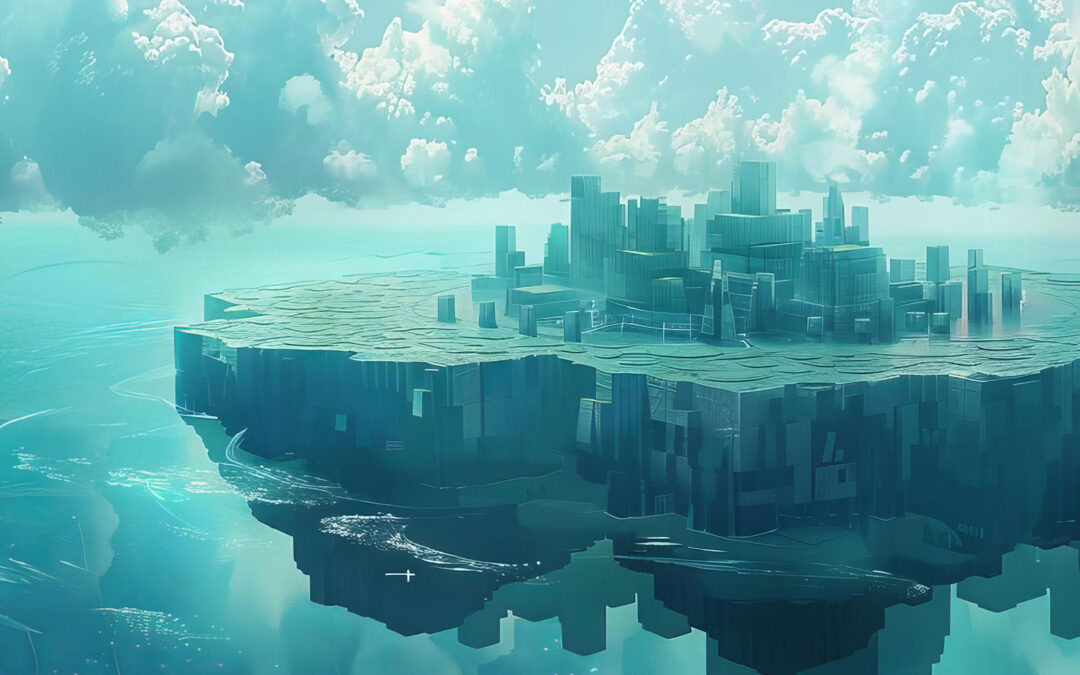
That is where the idea of The Island comes in.
In the theoretical framing that kicked this whole line of thought into motion,4See Choose ye an island!: Rethinking the Future of Thelema in an Unstable World The Island is not necessarily a literal island (though wouldn’t that be nice!). It’s a deliberate micro-society—small enough to be coherent, structured enough to function, and networked enough to avoid the fatal weakness of single-location utopian experiments. The inspiration is partly Balaji Srinivasan’s “network union/network state” approach (whether one loves it, hates it, or simply side-eyes the cryptocurrency mystique), but the real nerve of the idea is simpler: online community must become offline trust, and offline trust must become mutual provision. And then it has to be motive in the sense of occupying dynamic space along multiple lines of survival.
That practical move matters because modern occult culture is very good at identity and very bad at endurance. We have endless microgroups, endless symbolic flags, endless factions, endless Discord servers that flare up like paper lanterns and then burn out. Meanwhile, groups on other ends of the cultural spectrum—especially those we’d rather not emulate—have been resourcing, building institutions, buying land, training their people, and thinking/planning in the span of decades.
The Island, then, is not about retreating from society like frightened hermits. It’s about building an alternative form of social coherence that can withstand pressure without turning into a bunker-cult or a cosplay commune.
And here is where a hard point needs to be made—especially for Thelemites, who are often allergic to boundaries until they suddenly become obsessed with them. A Thelemic community that is only Thelemites is not a community. It is a sect. And sects, even when they start with good intentions, are structurally prone to becoming cultic—high on bonding, low on bridging, and eventually convinced that everyone outside the walls is either a threat or a lesser life-form (I mean, seriously: the O.T.O. troglodytes comment in Liber CI, anyone?).
Putnam’s distinction is useful here: bonding social capital strengthens ties within a homogenous group; bridging social capital connects people across differences.5Putnam, R. D. (2000). Bowling alone: The collapse and revival of American community. Simon & Schuster, 22. Bonding can make groups resilient internally, but it can also become excluding and insular; bridging is what keeps a community from becoming a sealed jar that ferments its own paranoia.
This is not an argument against Thelemic identity. It’s an argument against confusing identity with ecosystem. A real community—especially one trying to endure instability—must be porous enough to include non-Thelemic participants: spouses, friends, neighbors, allied practitioners, the basic “I’m not one of you, but I like you, and I’ll help you move a couch” people. It must be capable of service and reciprocity beyond its own symbolic boundaries. Otherwise, it becomes the spiritual version of an HOA: small, self-referential, and primarily concerned with policing who belongs. And no one survives that.
There’s also a safety reason for this, and it’s worth saying plainly. High-control groups don’t usually begin by announcing themselves as high-control groups. They begin by intensifying belonging, narrowing information channels, and treating dissent as betrayal. Models of undue influence, such as Hassan’s BITE framework6Freedom of Mind Resource Center. (2023, January). Dr. Hassan’s BITE model of authoritarian control. freedomofmind.com. https://freedomofmind.com/wp-content/uploads/2023/08/BITE-model.pdf (Behavior, Information, Thought, Emotional control), are not perfect diagnostic tools, but they’re excellent warning signals: if the community’s structure encourages control rather than consent, isolation rather than integration, fear rather than responsibility, then something has gone wrong.
So, what all this means is that The Island must be built in a way that resists those failure modes by design: transparency, distributed authority, real conflict resolution, and—yes—intentional inclusion of non-Thelemites and other adjacent participants. If The Island cannot coexist with the mainland—so to speak—it is not an island. It is a prison with incense.
That brings us to the pragmatic side. The original theoretical proposal is presented in three movements that can be translated, almost cleanly, into a realistic plan: choosing an island, fortifying it, and then building offline trust and physical nodes. The trick is to take those phrases and treat them like project phases rather than poetic inspiration.
First, define what The Island is in terms that are implementable. It is not a single compound. A single compound is vulnerable to leadership collapse, internal schism, local political pressure, natural disaster, financial crisis, and the simple reality that humans get weird when trapped in the same small fishbowl. A federated model is saner: a network of local nodes—small groups in multiple locations, even if those locations are “just over the next hill”—tied together by shared principles and mutual support, but not dependent on a single piece of land or a single personality. My original article framed this idea as “a federation of monasteries,” each with its own flavor, but held together by an overarching governance. But even that is too limiting (and cultish) by my choice of “monasteries” as the descriptor. Not that someone couldn’t build such an idea, either singularly or within a larger community, but starting a cult isn’t the goal here.
That federated structure is not just an aesthetic preference. It’s a resilience strategy. Distributed systems fail differently. That’s the point. When one node struggles, the network absorbs. When one leader burns out, the mission continues. When one region suffers an outage or a policy shift or a supply shock, other regions remain functional and can provide support. Centralized utopias (always) collapse like glass. Federations (in theory) bend like living wood.
Second, define sustainability as a stack of capabilities rather than a single virtue. One of the most common delusions in this space is thinking that “community” means “we all like each other,” and “sustainability” means “we planted kale.” Real resilience planning treats a community as an interdependent web of people, buildings, infrastructure, finances, governance, and relationships. If The Island is going to be more than poetry, it has to build capacity in that whole stack, even if it does so in small steps.
Which brings us to method.
A realistic plan needs to stop improvising and start cycling: define, set goals, build projects, measure outcomes, iterate. That’s not bureaucratic soullessness; that’s how you keep a vision from becoming a personality cult. NIST’s resilience guidance (and similar frameworks used across emergency management and community planning) is basically a discipline of asking: “What hazards are we anticipating? What functions must we preserve? How quickly must we recover? What resources do we have? What are the dependencies?”
So here is the plan, written in phases that are intentionally boring, because boring is how you survive.
- Phase Zero: Found the startup society. This is the easy part, and it’s also where many projects die because they never outgrow it.
As Srinivasan puts it, it begins as an online community with aspirations, and legitimacy comes from people opting to follow. Fine. But a startup society must do more than talk. It needs three immediate deliverables: (a) secure communications (at least better than “everything is public forever”), (b) a minimal governance document (call it a charter, call it bylaws, call it “this is how we don’t implode”), and (c) a membership pathway that is clear about expectations without becoming purity policing.
This is also where the non-Thelemic inclusion must be built in from the beginning rather than treated as an awkward afterthought. Membership does not have to mean initiatory identity. You can have layers: participants, supporters, allies, members with voting rights, members without voting rights, and so on. The point is to create a structure that allows people to belong at appropriate levels without coercion or artificial intimacy. If every participant must become “one of us,” you’ve already lost.
- Phase One: Become a network union. “Union” here does not mean labor activism against a specific corporation; it means an online community organized into a group capable of collective action for mutual benefit. In practice, that means shifting from vibes to roles.
This is where working groups are formed, not as committees to generate documents nobody reads, but as teams with concrete deliverables: mutual aid logistics, training and skills, financial stewardship, communications, conflict resolution, local partnerships. The whole point is to translate the social energy of the group into tangible capacity. If The Island can’t coordinate to help one member in crisis—job loss, eviction risk, medical emergency, a family breakdown—it cannot coordinate to withstand broader instability. The “network union” phase is the muscle-building phase.
And again, inclusion matters here: the various working groups should interface outward. Local partnerships, service projects, mutual aid that benefits neighbors, not only insiders. That outward-facing posture is both ethically necessary and practically intelligent. It generates bridging social capital—relationships across differences—and bridging is what keeps communities from becoming brittle, paranoid, and socially irrelevant.
- Phase Two: Build offline trust. This is where the romantic idealists either get sober or get bored. Online trust is not nothing, but it is thin. Offline trust is built through shared labor, shared meals, shared inconvenience, and the slow accumulation of “I’ve seen how you behave under pressure.” This means regular in-person meetups, skill days, service projects, and small regional gatherings. The point is not to create a constant festival. The point is to turn anonymous usernames into accountable human beings.
- Phase Three: Crowdfund physical nodes. “Nodes” are not necessarily communes. Nodes can be a shared meeting space, a small property used for training and retreat, a co-op storefront, a rented facility that functions as a logistical hub (though owning property is preferable to renting, something is better than nothing). The key is that nodes have baseline capacity: storage, communication redundancy, a plan for sheltering people in the short term, and a local network of relationships. This step can be done without buying a fortress. In fact, it probably should be, at first.
- Phase Four: Formalize the federation. If multiple nodes exist, The Island becomes a living organism rather than a single project. This is where shared standards matter: financial transparency, safeguarding policies, dispute resolution processes, and decision-making structures that prevent charismatic drift. It’s also where autonomy matters: each node adapts to local reality while still participating in the shared framework. A federation is not a uniform monoculture. If it becomes one, it will fracture anyway—because humans do not actually thrive in monoculture, they merely endure it until they revolt.
And that is where we stop—for now—because everything after this point becomes technical: infrastructure, economics, governance mechanics, risk analysis, metrics, and the unglamorous reality that sustainability is mostly maintenance. The good news is that the unglamorous reality is also the doorway into something real. The Island does not have to be a fantasy. It can be a plan built incrementally, tested in public, corrected with humility, and made porous enough to remain a community rather than a cult.
The strangest part is that this is true whether or not the world “falls apart.” The Island is worth building even if nothing dramatic happens, because stability is not merely the absence of crisis. Stability is what you get when people have each other, and they’ve built something that can hold.
Love is the law, love under will.
Footnotes
- 1Frankly, I don’t think we have to assume this at all if we look objectively at the world around us. This is practically a given at this point. ↩︎
- 2Community resilience. (2025, September 24). NIST. https://www.nist.gov/community-resilience ↩︎
- 3Though we’ve turned most of it, including the A∴A∴ grades, into more of an academic exercise and placeholder positioning rather than actual attainments as defined by Crowley. ↩︎
- 4See Choose ye an island!: Rethinking the Future of Thelema in an Unstable World ↩︎
- 5Putnam, R. D. (2000). Bowling alone: The collapse and revival of American community. Simon & Schuster, 22. ↩︎
- 6Freedom of Mind Resource Center. (2023, January). Dr. Hassan’s BITE model of authoritarian control. freedomofmind.com. https://freedomofmind.com/wp-content/uploads/2023/08/BITE-model.pdf ↩︎