
Do what thou wilt shall be the whole of the Law.
Thelemites are “thrice-born”; we accept everything for what it is, without “lust of result,” without insisting upon things conforming with à priori ideals, or regretting their failure to do so. We can therefore “enjoy all things of sense and rapture” according to their true nature.1Crowley, Aleister. 1996. The Law Is for All: The Authorized Popular Commentary to Liber AL vel Legis sub figura CCXX, the Book of the Law. Edited by Louis Wilkinson and Hymenaeus Beta. New Falcon Publications, 111.
Varieties of Religious Experience
In The Varieties of Religious Experience, William James offers a contrast between individuals who are “once-born” and “twice-born.” Crowley builds on this by adding an additional layer and suggesting that Thelemites are “thrice-born.” I endeavor to make some sense of this as he touches nowhere else on this subject matter.
Fowler’s Stages of Faith Development
Methodist minister James Fowler—who only died about a decade ago—was famously known for his seven stages of faith development. While this is only one of several models I teach students in a survey of psychology, I’ll run through these stages briefly, as they provide some context for understanding religious development in a broader perspective.
Stage 0: Undifferentiated Faith
Fowler’s undifferentiated faith development stage generally lasts from birth through about two years old.2Piaget’s sensorimotor stage of cognitive development and Erikson’s trust versus mistrust stage of psychosocial development. Children experience faith as a connection between and as an extension of themselves and their caregivers. This is a very primal level of spiritual development.
Stage 1: Intuitive-Projective Faith
Prior to entering school (ages three to five), children begin to develop language and the ability to work with symbol sets.3Piaget’s pre-operational stage of cognitive development and Erikson’s initiative versus guilt stage of psychosocial development. But they have yet to develop any kind of concrete religious beliefs. Faith remains an experiential development shaped by stories, myths, images, and the influence of others. There is an intuitive sense of right and wrong, a primitive (animist) sense of how the universe works, and ritualistic involvement [learning] from their family and religious community.
Stage 2: Mythic-Literal Faith
As with all stage theories, this is where Fowler’s starts to break down. I’ll show you why.
The mythic-literal stage is generally about ages six to twelve. This is when children start to develop logical reasoning.4Piaget’s concrete operational stage of cognitive development and Erikson’s industry versus inferiority stage of psychosocial development. They start working out the differences between facts and fantasies. Authority extends beyond their parents to teachers and friends, yet they still don’t have the full mental capacity to sift through a complete sense of truth and speculation. While faith remains experiential, as in the last stage, because children in this stage of life are more concrete and literal thinkers, it becomes solidified through the stories and rituals of religion (e.g., deities are nearly all anthropomorphic, myths and scriptures are taken literally, etc.).
While most theorists believe humanity as a whole never makes it past Stage 3, I believe a large portion, if not a majority, never makes it past Stage 2. I fully admit this is a personal bias.
Stage 3: Synthetic-Conventional Faith
In our teenage years—from about thirteen to eighteen5Piaget’s formal operational stage of cognitive development starts at about twelve and is the final stage of development of that model. Erikson’s intimacy versus isolation stage of psychosocial development starts at eighteen but goes up to forty. Both of these would cover the rest of Fowler’s Stages Three, Four, and Five. Stage Six isn’t reached by enough individuals to be fully covered by either of these developmental models.—we start thinking abstractly. We start working through moral constructions and problems. This also corresponds with Kohlberg’s post-conventional morality and being able to see a larger picture of moral principles at work. Because of abstract thinking, what were once mere stories, rituals, and symbols of faith have layers of additional meaning and alternative perspectives. People can see views from others’ perspectives and imagine not only their own faith but also the faith of others. Finally, this is the stage in which one can claim their faith as their own rather than as the “faith of their family.”
Again, most people never make it past this stage, if they ever reach it at all.
Stage 4: Individuative-Reflective Faith
This stage begins around eighteen to twenty-two years old and is typically the start of significant questioning of faith traditions and authority. Around this time, there is a level of dissonance associated with independence and the separation of the young adult’s family life. Many times, youth at this stage of life are leaving home and their religious community to find answers they felt were not clearly provided for within those communities or at home. This is a time of greater ownership of a personal faith.
Stage 5: Conjunctive Faith
If this stage is reached at all, it is typically reached in one’s thirties. At this point, individual self-development gives way to community faith development. This stage is where one forms a pluralistic faith and finds other people’s faith informing and deepening one’s own faith.
Stage 6: Universalizing Faith
This is a level of universal pluralism. According to Fowler, it is rare for a person to reach this stage of faith, which is considered action rather than activity. This distinction is essential. Fowler considered the great teachers of various religions to have reached this stage despite their allegiance to a specific religious path.
I would say this stage is an integral faith, but I would be showing my bias. Again.
Three Varieties of Religious Experience
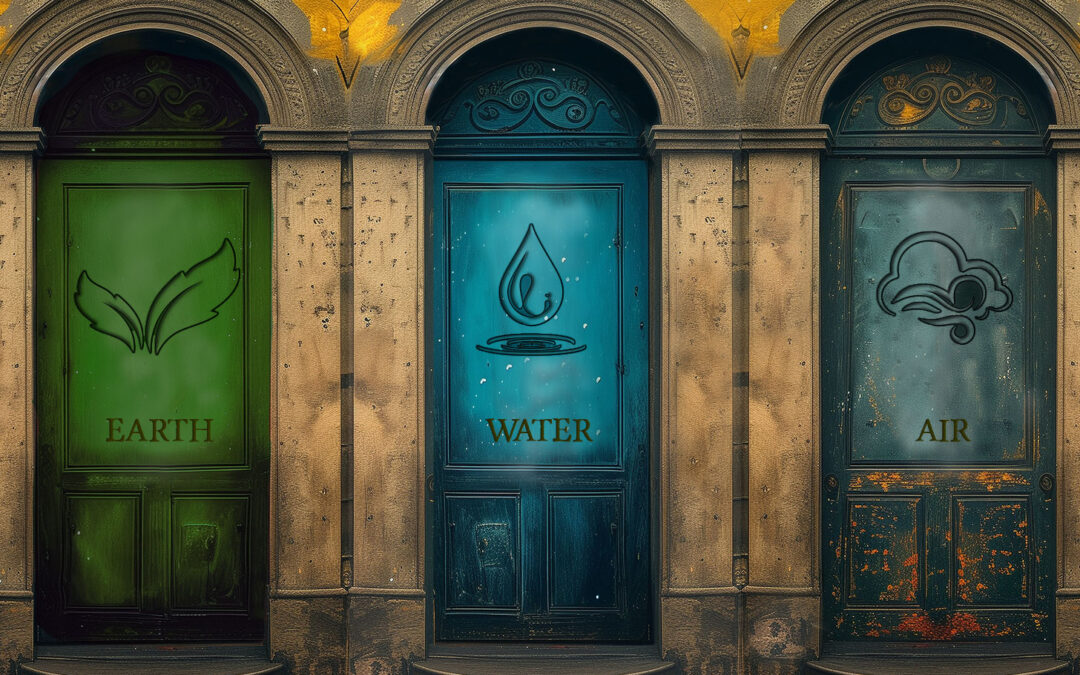
Once-Born (Earth)
Each of us is once-born of earth, symbolizing flesh and blood. That’s simple enough. Most myths of the world start with some kind of dust/mud/muck/clay earth-style creation of humanity. The biological processes encompassing our incarnation fall within the purview of medicine and science. Indeed, we could speculate further—reincarnation and all that—but it is irrelevant for our pursuits forward. This isn’t about our essential-ness.6Crowley and I are in agreement that the essential nature of every star is identical [see Crowley, Aleister. 1994. “Woman—Her Magical Formula.” In Magick Without Tears. New Falcon Publications, 252.]. It is only in Motion (Hadit) and Direction (HGA/True Will) that we find our “variety” and difference (individuality). This is about our incarnated, existential-ness. In short, we’re born. Not all that complicated. Not all that controversial, either.
But the nature of the once-born is that of the condition of children (whether actual children or child-like naivety in approach to one’s worldview): predisposed to a certain simplicity and primitive happiness “out of the box,” one might say. Once-born is a state of existential optimism. James distinguishes their happiness with an involuntary, almost abstract dismissal of evil in the world. They believe in a simple, uncomplicated (child-like) life.
James says of the once-born, that “evil simply cannot then and there be believed in, [it must be ignored, and] he may then seem perversely to shut his eyes to it and hush it up.”7James, William. 1922. The Varieties of Religious Experience. Longmans, Green, and Co, 88. The once-born, much like the children they are, literally and metaphorically, stick their fingers in their ears and singsong, “la la laa, la laa, la!” to anything that doesn’t fit their caricature of a perfect worldview.
The once-born is associated with the Aeon of Isis, the alleged age of innocence.8In a more formal essay on aeonic theory, I would dispute the idea of an age of innocence or even a matriarchal age. But let’s roll with it for the moment to be consistent with Crowley’s original thoughts. I concede this would be the closest to the “matriarchal concept” found in Crowley’s writings that isn’t bogged down in grotesque misogyny.
We can see some shades of Fowler’s Stage 0 and Stage 1 here in this concept of the “once-born”: the undifferentiated faith, the lack of separation between the physical and the spiritual, the refusal to see beyond the immediacy of momentary gratification.
However, I would go so far as to suggest with the advent of modernity, the once-born have succeeded in coming into an age of cynicism that has replaced that innocence, that sense of perverse blindness to evil in the world, and have instead found their way to divert the renewal of the second birth (twice-born) into a mire of therapy-speak and spiritual bypassing. Within occulture, they have replaced the cathartic work of spiritual formation with the distractions of YouTube. They are still the once-born—the earth children—but twisted and toxic.
Twice-Born (Water)
The twice-born is of water. When Christians speak of being “born again,” they refer to spiritual renewal—a second birth that brings more profound insight into their spiritual nature. It is no stretch to understand the symbolism of baptism in Christianity and, in general, the water rites of various religions and initiatory systems that constitute ‘second births.’
William James says of the second-born, “The process is one of redemption, not of mere reversion to natural health, and the sufferer, when saved, is saved by what seems to him a second birth, a deeper kind of conscious being than he could enjoy before.”9James, The Varieties of Religious Experience, 157. (emphasis mine)
It is this “deeper kind of conscious being” that I find to be the most crucial part, especially from the perspective of integral theory. What we have is a second layer of consciousness, a deeper layer. Second sight, a new vision, a spiritual depth of recovery that leads to both the nature of conflict and the attempt at reconciliation between the flesh and the spirit that all seems to be the result of this second birth. These layers of consciousness become deeper as we move through each birth.
Yet with this second birth comes a sense of pessimism toward the world, a sense of dissatisfaction. James says the second-born now contrasts the world of the flesh with the world of the spirit. The second-born sees the primitive, material world as dark and malevolent and the spirit world as bright and beckoning—very Gnostic in outlook, in fact. For some, the cycle of suffering rises to importance as the impetus for the continual need for alteration in their environment, perspective, life circumstances, or just a sense of escapism—even if this escapism is “escaping this world for the next one.” (This is contrasted with the thrice-born’s innate acceptance of change, which does not require alteration or escapism but accepts change ‘as is.’)
The twice-born is associated with the Aeon of Osiris. This second birth directly relates to the motifs of death and resurrection—including the descent into hell (what Crowley calls the ‘core of the star, the house of Hadit’)—which is connected to the previous aeon and its IAO formula that “remains valid [in the current aeon] for those who have not yet assimilated the point of view of the Law of Thelema.”10See Crowley, Aleister, Mary Desti, and Leila Waddell. 1997. Magick: Liber ABA. Edited by Hymenaeus Beta. Weiser Books, 159. It is psychologically associated with the development of self-awareness, as seen in the coming-of-age and fall-of-man myths, in which humanity gains knowledge as it rises from a primitive, innocent (once-born) state and finds its spiritual fulfillment (the cyclic opposite) in the dying-and-rising savior myths, that is, in a state of rebirth.11This essay does not approach the Three Schools of Magick hypothesis at all but remains focused on the primary genetic thread of Thelema’s spiritual transmission. It also does not attempt to reconcile historical discrepancies within Crowley’s aeonic dating scheme but instead uses his aeonic terms descriptively rather than prescriptively.
While primarily contained within Fowler’s Stage 2, there are some elements of Stage 3 here as well.
Thrice-Born (Air)
The thrice-born is of air, of pneuma (πνεῦμα, lit, breath12For those who see the pattern in these three “births,” it is the baptism(s) of blood, water, and breath—representative of the greater mystery of O.T.O.), and it is here that we reach the second spiritual birth. In short, the thrice-born are those for whom living experientially is as natural as breathing—to be trite (and punny) about it.
Sidebar: Greek Lesson
It is little wonder that many—specifically Christians—having only the revelation of the second birth, necessarily see the Devil as the Prince of the Power of Air (τὸν ἄρχοντα τῆς ἐξουσίας τοῦ ἀέρος).
A quick Greek lesson is in order here. In the Christian bible, there are two Greek words for air: οὐρανός (ouranos) and ἀήρ (aēr, the origin of our English word). The former is used for ‘the heavens’ or ‘heaven’ (and very rarely for ‘sky’). The latter is used for ‘sky’ but never for ‘heaven.’ In the Greek version of the bible, οὐρανός is what Genesis 1:1 uses for ‘heaven’ for In the beginning God made the heaven and the earth. For reference, ἀήρ is the domain between heaven and earth, the living space of humanity. And it is here, that Christians believed was the kingdom of the Devil.
The point to make here is that the domain of air, the domain of the Devil, is where we physically exist. It is the material space in which we live our lives. For the twice-born (the water-born), the fear of existence, the fear of this present life, manifests in the belief in a supernatural Devil, the temptations of existence, and the need for both a savior and an afterlife that is free of that Devil and resolves the uncomfortable conflicts of this present life. Those born of air already exist within this space and are therefore viewed as demonic by the second-born.
The thrice-born are those who “accept everything for what it is, without ‘lust of result,’ without insisting upon things conforming with a priori [theoretical] ideals, or regretting their failure to do so. [They] can therefore ‘enjoy’ all things of sense and rapture’ according to their true nature.” Crowley goes on to say they accept each event and circumstance “for what it is, and finds interest in it for its own sake. For him it is a necessary part of the Universe; he makes ‘no difference’ between it and any other thing.”13Crowley, The Law is for All, 111 (emphasis mine).
Whereas the once-born have an undifferentiated experience of faith in which only those experiences that fall within their unadulterated view of the world are accepted, the unresisted (or integrated) experiences of the thrice-born accept all available experiences as part and parcel of their lived experience itself. What Wilber calls the “pre-/post-trans fallacy” arises from a misunderstanding of the distinction between undifferentiated and unresisted experiences.
It should be noted, despite the hubris of many Thelemic talking heads, that not every experience is meant for every individual. It’s not about forbidden experiences but about available experiences. It is truthful (subjective) that nothing is forbidden, but it’s not true (objective) to say that all is available. There are many reasons—geography, genetics, grasp—for an experience to be outside the range of availability. Accepting these facts without ‘insistence’ or ‘regretting their failure’ to meet expectations is the attitude of the thrice-born.
The thrice-born is directly related, of course, to that of the Aeon of Horus. However, it is important to understand the difference between the developmental stage of a child and the developmental stage of the Aeon of Horus, the so-called “Aeon of the Child.” Crowley’s unfortunate grasp of dispensational theology and poor use of dialectics regularly confuse Thelemites into thinking the latter is anything remotely similar to the former. But you can also see the strands of Freud here. Freud reduced all higher states of consciousness to infantile impulses: the god was reduced to the brat, and the universe was reduced to sex. We know both—the aeon and sex—are a good deal more complicated. But it would seem Crowley did not.
In my opinion, the “thrice-born” should be more around (if not fully into) Fowler’s Stage 5, at least, and reaching into the shadows of Stage 6. But, more logically, I think this “thrice-born” stage is set off within and through the completion of Fowler’s Stage 4.
Important Warning
This pre/post fallacy—the assumption that pre-conventional stages of consciousness are analogous to post-conventional states of consciousness merely because they are both irrational—is one of the most significant stumbling blocks throughout modern Thelemic spiritual bypassing.14You see this consistently in several YouTube gurus, specifically JL—, which is no surprise given one of his biggest influences is BS—, a failed psychologist of Thelemic notoriety with little experience in such matters. One has to be careful here to distinguish between “accept everything for what it is, without ‘lust of result’” and a sense of learned helplessness or toxic positivity. There is a chasm of difference between accepting the desolation of the Dark Night of the Soul and accepting (and treating) clinical depression.
One of my few critiques of Phyllis Seckler (Soror Meral) is her victim-blaming throughout her letters. Crowley did it as well, though he was at the dawn of psychology as a science about the same time as the rise of Darwinism. It was a terrible and tragic combination. The field had barely understood the significance of consciousness, much less emotions in conjunction with behavior, or even the cultural and systemic contributions to mental health.
Psychology has come a long way since Crowley’s time. And even Seckler’s.
A Thelemic Model of Religious Development
Utilizing the three varieties of religious experience explicated above, I’d like to offer a brief outline toward a Thelemic Model of Religious Development.15I welcome feedback, further development by others, and even collaboration to expand this model. Nothing here is set in stone.
Note: This is not a true (empirical) model. It is purely a personal conjecture drawn from the intersection of information both from empirical data of existing studies on religious development and the assertions of both James and Crowley concerning their thoughts on the varieties of religious experience. For the moment, it’s just for fun.16Remember when we used to do things like that with our worldview structures? Just see how far we could push things for the fuck of it? Yeah. This is one of those times.
One of the poor assumptions many Thelemites make—and, indeed, most occultists in general—is that religious (or faith) development through our life span, specifically the early years of childhood, equates to indoctrination. The assumption that religion (or spirituality, if you prefer) is entirely psychological and has no cultural or systemic value is not only absurd but not born out by the evidence. The other (bad) assumption is that we start as a blank slate (tabula rasa) and just work our way blindly from there.
Once-Born
We all start out once-born, literally at birth, but also developmentally from birth. I think we could make a case for James’s undifferentiated faith combined with Fowler’s Stage 0 and Stage 1 for sure, and into some, if not most, of the awakening of Stage 2. I would suggest that, in a developmental sense, “once-born” extends from birth through puberty.
Frankly, I think it is okay to allow and even encourage this level of childish innocence and exploration of faith. While Crowley was off on a few things when it came to the education of children, he wasn’t wrong in the broad strokes when he wrote, “Let [children] think and act for themselves; let their innate integrity initiate itself! Make them explore all life’s mysteries, overcome all its dangers.”[m fn]Crowley, Aleister. 1998. “On the Education of Children,” In The Revival of Magick and Other Essays. New Falcon Publications, 127.[/mfn] Crowley missed the need for creativity in child rearing, but we can write that off as a result of being misled by scientism and social Darwinism.
It is natural for children to be caught up in the creative shaping of their environment that does not conform to “facts and figures,” or to “behold all facts scientifically.”17Crowley, 1998, “On the Education of Children,” 127. His idea that a child’s fantasy life “must be cauterized by insistent confrontation with the repugnant realities”18Crowley, 1998, “On the Education of Children,” 127. is so absurd as to be harmful to healthy childhood development. Despite Crowley’s best attempts to pretend otherwise, most early childhood falls into a pre-rational developmental stage (until about age six), followed by a primitive rationality until puberty.
However, a healthy development that provides both creative thinking and critical thinking to serious questions through age-appropriate answers will provide for a far better foundation into later years throughout all lines of development, not merely spiritual development. But there is nothing “stunting” about a child creatively entertaining gods and goddesses, heroes and villains, in primitive good versus evil moral stories, so long as equal time is given for critical examination of the underlying ethics involved (again, from an age-appropriate perspective). But a slow, natural spiritual development, providing suitable materials for deeper understanding, is entirely appropriate when the child asks for it.
I will add here, quickly, that many (not all) of Crowley’s educational ideas sound a lot like layman’s versions of the pedagogical approach developed by Maria Montessori and used today in Montessori schools around the world. He wasn’t all that far off the mark, is my point. He just wasn’t entirely sound in his approach due to a lack of expertise in the field.
Twice-Born
I think any time after puberty is a natural time for the spiritual awakening of the “second-born.” I am not convinced that such a spiritual awakening is purely “an adult” thing. But I assert that such an awakening is outside the realm of a pre-pubescent developmental stage and is harmful to push on young children, such as Christians attempting to have their kids “saved” during altar calls, summer camp, and the like.
I’m not putting a specific age on this—just “after puberty”—though I recognize that puberty can happen abnormally early for some children. I’d like to think that any model is examining the mean of experience rather than every exception involved. If pressed, I would suggest that age sixteen and older is more likely than an earlier age of eleven to fifteen. But I wouldn’t rule out the possibility of an earlier awakening either. This would make the “second-born” both a natural and an intentional developmental stage, meaning it is part of “growing up” but also something that can be induced through life experience.
Generally, the “second-born” will have mid- to late-Stage 2 from Fowler’s model and, if raised with Thelemic values (this is a proposed Thelemic model, after all), move into the early part of Fowler’s Stage 3. Much of our existential crisis during our teenage years comes from the concrete, literal way in which we think during this developmental (age) stage being internalized without a corresponding spiritual development.
Yet, if we are to take James seriously, this awakening of the “second-born” involves this crisis and resolution of the existential gulf between finally seeing the world through the lens of “good versus evil” and trying to make sense of it. It is the breakdown of concrete, literal thinking and movement into abstract thinking that contributes to this “faltering of faith.”
It is not without notice in many religions that children are “renamed” or take on a “second name” during a ceremony of confirmation or baptism at this time.
Thrice-Born
The “thrice-born” is an intentional development stage of adulthood. Well past Fowler’s Stage 4, most likely into Stage 5 for sure, but I’m not inclined to include Fowler’s model at all at this point. The “thrice-born” move past and beyond this experiential divide of a personal sense of “good” and “evil” and, as Crowley writes, “accept everything for what it is, without ‘lust of result,’ without insisting upon things conforming with à priori ideals, or regretting their failure to do so.” This is a very difficult perspective to take, quite frankly. It also requires a highly developed sense of anti-morality to grasp a larger sense of justice while adhering to a modality of nonintervention in the Will of another.19While not appropriate for this essay, Crowley was quite clear that only one who had attained the stage (not state) or Grade of a Master of the Temple was able to clearly delineate the finer details of ethics that might seem abhorrent to the average individual. Those Übermensch types have yet to reach that state, much less stage, and can’t argue ethics out of a paper bag.
To be “thrice-born” is not merely to awaken but to integrate. It is not the return to innocence of the once-born or the tortured rebirth of the twice-born, but the reconciliation of both within the full spectrum of lived experience. The thrice-born is not detached from the world but breathes it in, understanding that transcendence is not escape but participation. Crowley’s insight points toward a stage of spiritual maturity where faith ceases to be reactive and becomes a motive—no longer rejecting the world or seeking to transcend it, but instead inhabiting it consciously, wholly, and without apology.
Unfolding Development
This model—once-born, twice-born, thrice-born—reveals an unfolding of consciousness that parallels both individual and cultural evolution. Humanity itself may be in the throes of its third birth, struggling with disillusionment and dualism, still learning that redemption does not lie in rejecting the material world but in realizing its divinity that isn’t different at all from the experience of life in its manifest diversity. Thelema, then, is the call to the third birth: to breathe the air of lived experience without fear, to act without lust of result, and to see every moment as the necessary expression of the infinite. In this way, the thrice-born is not the culmination of faith, but its liberation.
Love is the law, love under will.
Footnotes
- 1Crowley, Aleister. 1996. The Law Is for All: The Authorized Popular Commentary to Liber AL vel Legis sub figura CCXX, the Book of the Law. Edited by Louis Wilkinson and Hymenaeus Beta. New Falcon Publications, 111.
- 2Piaget’s sensorimotor stage of cognitive development and Erikson’s trust versus mistrust stage of psychosocial development.
- 3Piaget’s pre-operational stage of cognitive development and Erikson’s initiative versus guilt stage of psychosocial development.
- 4Piaget’s concrete operational stage of cognitive development and Erikson’s industry versus inferiority stage of psychosocial development.
- 5Piaget’s formal operational stage of cognitive development starts at about twelve and is the final stage of development of that model. Erikson’s intimacy versus isolation stage of psychosocial development starts at eighteen but goes up to forty. Both of these would cover the rest of Fowler’s Stages Three, Four, and Five. Stage Six isn’t reached by enough individuals to be fully covered by either of these developmental models.
- 6Crowley and I are in agreement that the essential nature of every star is identical [see Crowley, Aleister. 1994. “Woman—Her Magical Formula.” In Magick Without Tears. New Falcon Publications, 252.]. It is only in Motion (Hadit) and Direction (HGA/True Will) that we find our “variety” and difference (individuality).
- 7James, William. 1922. The Varieties of Religious Experience. Longmans, Green, and Co, 88.
- 8In a more formal essay on aeonic theory, I would dispute the idea of an age of innocence or even a matriarchal age. But let’s roll with it for the moment to be consistent with Crowley’s original thoughts.
- 9James, The Varieties of Religious Experience, 157. (emphasis mine)
- 10See Crowley, Aleister, Mary Desti, and Leila Waddell. 1997. Magick: Liber ABA. Edited by Hymenaeus Beta. Weiser Books, 159.
- 11This essay does not approach the Three Schools of Magick hypothesis at all but remains focused on the primary genetic thread of Thelema’s spiritual transmission. It also does not attempt to reconcile historical discrepancies within Crowley’s aeonic dating scheme but instead uses his aeonic terms descriptively rather than prescriptively.
- 12For those who see the pattern in these three “births,” it is the baptism(s) of blood, water, and breath—representative of the greater mystery of O.T.O.
- 13Crowley, The Law is for All, 111 (emphasis mine).
- 14You see this consistently in several YouTube gurus, specifically JL—, which is no surprise given one of his biggest influences is BS—, a failed psychologist of Thelemic notoriety with little experience in such matters.
- 15I welcome feedback, further development by others, and even collaboration to expand this model. Nothing here is set in stone.
- 16Remember when we used to do things like that with our worldview structures? Just see how far we could push things for the fuck of it? Yeah. This is one of those times.
- 17Crowley, 1998, “On the Education of Children,” 127.
- 18Crowley, 1998, “On the Education of Children,” 127.
- 19While not appropriate for this essay, Crowley was quite clear that only one who had attained the stage (not state) or Grade of a Master of the Temple was able to clearly delineate the finer details of ethics that might seem abhorrent to the average individual. Those Übermensch types have yet to reach that state, much less stage, and can’t argue ethics out of a paper bag.