
Do what thou wilt shall be the whole of the Law.
Special Dispatches are one-off releases, without a set schedule, on topics based on observation of something in the community or just personal reflection. They may be polemical or apologetic, or they just may be a response to a topic of timely importance.
Part of a larger work that I’ve been slowly and thoughtfully writing since I first exposed to Jung’s Red Book about fifteen years ago, I’ve spent a great deal of time—though in short bursts—working to tap into something beyond the usual approach to my larger continuum of writing via an exploration of my own values, evolution, and various mystical experience throughout my life’s journey. What is tentatively titled Liber Viarum, the ‘Book of Paths,’ has been a dumping ground for weird and difficult-to-explain dewdrops that seep out of my soul. I hesitate to call them “visions,” but what else would I call them. My expectation is that it won’t be finished before I’m dead, though stranger things could happen.</P.
I rarely share anything from this work with others, aside from excerpts stripped of context. This will be the first time I’ve put this selection from the opening chapter online. These are the first two pieces I’d written to start the book itself. All else has flowed from here.
I don’t have any illusions that it means anything to anyone beyond myself. But I share it nonetheless in an effort to submit to you something different than my typical “realist” offerings.

The Labyrinth
Then came an eagle from the abyss of glory and overshadowed him. So black was the shadow that he was no more visible. But I heard the lute lively discoursing through the blue still air. Ah! messenger of the beloved One, let Thy shadow be over me!
—Liber Cordis Cincti Serpente 2.31-33
There is no proper way to explain the composition of the labyrinth that rises up before me in this place than to say a dormouse quivering before Apedemak would still be too inadequate a comparison. The towering stones stretch in eight directions until the horizon swallows them in the haze of the distance. I am tempted to run from this place. It is not that I fear the emptiness beyond the opening into any of the abysses that lie beyond each corridor. The entrails strewn along the wall do not dissuade me. The remains, wrapped in the cloak of the Magister, casually tossed just to the interior of the opening nearby, do not cause me to tremble. It is not that I am a greater man than he. Surely not. I would not dare claim such in this place. Yet I have faced greater horrors in my life than what my own imagination can conjure in this moment.
No. It is the Truth that makes my lips bleed.
Words written in the blood from silent lips.
Prophecies written in the memories from stilled thoughts.
Moments lived in the chances from lost lives.
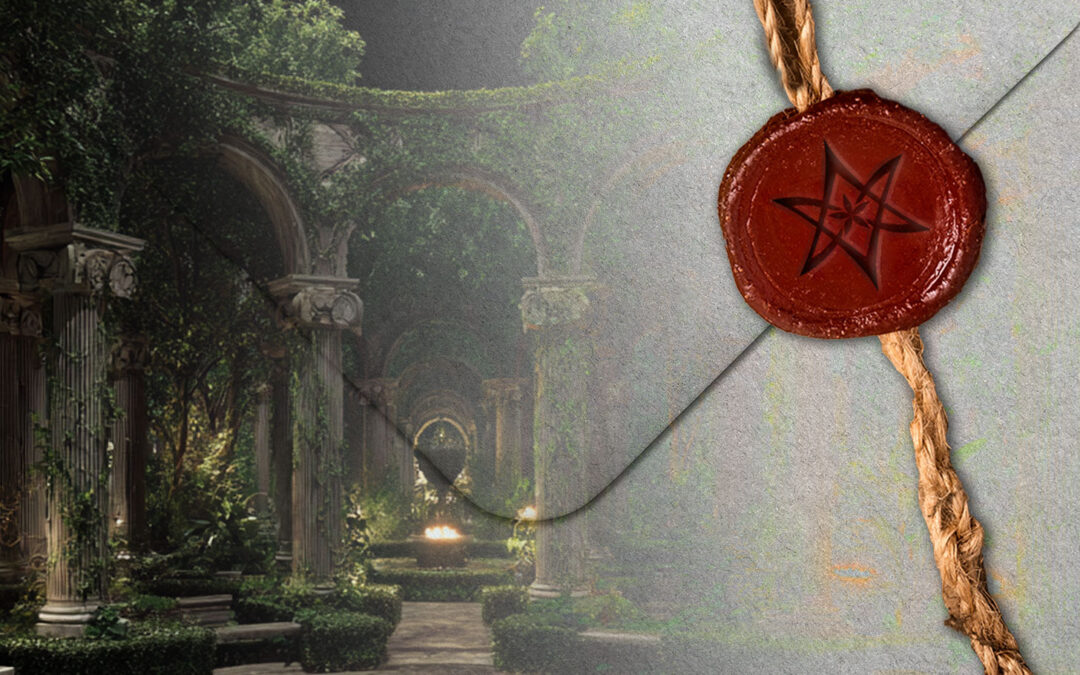
It is now that I tell you I believe myself to be currently resting in a quaint little garden in the direct middle of the labyrinth. It is a beautiful circular space despite the monstrosities that adorn the various pillars and alcoves. Otherwise noble fawns twisted up through foul combinations of demonic forms on doric pillars of dark granite are interspersed with layers of manicured hedges. In each of the cardinal and ordinal directions, where the labyrinth extends outward from the center, there stands a pool of the most reflective water, the stillness of which is punctuated by the eerie lack of breeze throughout the entire garden. At the center of each pool is a reclining mermaid, naked and frozen in all appearance save those terrifying eyes from which burn fire.
There is a moment over each of the preceding six days when the shadow of the Sun disappears into the oubliette at the center of this particular courtyard. When I say that the shadow disappears, that may be a slight misnomer in that it far more scurries into that hole in the ground and remains for a precise measure of eight double-beats of the heart. Whomp-whomp. Whomp-whomp. Whomp-whomp. Whomp-whomp. Whomp-whomp. Whomp-whomp. Whomp-whomp. Whomp-whomp. Slam! The gate of the oubliette so quickly opens and slaps shut, the sound startles me each time even when I know it’s coming. The shadow of the Sun returns, dusts itself off in quite a ruckus of earthen-grey ash, and continues its pace across the courtyard.
I am not entirely sure what the shadow of the Sun does there in the hole in the center of the courtyard in the center of the garden in the center of the labyrinth in the center of the universe. I just know that it disappears and that is quite disturbing.
Catechism of Eden
While sitting next to the rotting corpse of the Magister, the Silence speaks to me:
Do you know the Catechism of Eden?
“Before or after the Fall,” I reply.
Is there a difference?
“Isn’t there?”
I will teach it to you, though we will see how much you can intuit first since you have already made your way to the Garden. It starts with a sign, as such. The Silence—and how I can tell you this now is beyond the comprehension of the words that I can put down on paper—offers me the sign of bond between the Teacher and her disciple.
Let us begin.
1 What is the chief end of humanity? the Silence begins the Catechism.
“To walk in the garden of pleasure.”
2 What rule has been given to direct all of humanity?
“Does this not change with the seasons?” I reply.
It does, after a manner of speaking. It has been variously worded in the past, each for the best understanding to humanity in its season. There was a time when ‘Love your God’ and ‘Love your neighbor as yourself’ was the key to this rule. Today, the expression would be elucidated as ‘Love is the law, love under will.’
“Yet the final answer for the Catechism would be the rule of Love, would it not? An eschatological underpinning of the whole of human existence, that longing which pushes us forward and inward in a constant movement toward God?”
Yes. You are mostly correct. The answer to the question is simply “The rule of Love,” the Silence responds.
“What do I have mistaken?” I ask.
3 What does the rule principally teach? the Silence moves on, ignoring my question.
“I do not know how to answer that.”
You thought yourself smart before, but now you find yourself lost. Love teaches us “the interplay between unity and eternity.” This is the longing between that which has been divided and that which welcomes again.
You are children, born of the desire for change, thrust into a journey of experience. From the moment you breathe the first air, to the rush of the first fire in your blood, to the taste of the first water on your lips, and the feel of the first earth under your feet, you will never be the same. Each moment is, was, and shall be a new moment.
“You speak of the cycle of incarnation,” I say to the Silence. “Unity, the Zero, 0. Eternity, that manifestation of Unity as infinity, ∞ (or two zeros side by side, 00). Could it not be said that this is the same as 0=2?”
You limit yourself to what has come before or what you think will come ahead. You only have what is now. The unity is what you are. The eternity is what you are. You move constantly, moment by moment, through the paradox of the two.
But I ask now: 4 What guides us along our way?
“The Flame of Truth,” I respond.
What is Truth? the Silence asks.
“Did I not traverse the paths of Truth to reach the interior of the garden here? Each of the cardinal and ordinal paths of the labyrinth reach outward to form the inner and outer spokes of Truth, does it not?”
Speak more of them.
“The paths of Truth respond to the Four Questions of the Sages: A What do my hands teach me?, B What do my memories teach me?, C What do my Gods teach me?, and D What do my parents teach me?”
They do indeed correspond to those four elements of all truth. The wise will hear and see when they have ears and eyes to do so.
Tell me: 5 What defends us along our way?
“The Flame of Silence.”
6 What inspires us along our way?
“The Flame of Love.”
The Silence suddenly asks me, nearly passing over my last response, Can you explain further the nature of these three Flames?
“The Three Flames are movements within the soul. Truth burns away every borrowed name until only the bone of what-is remains. Silence burns inward, clearing the chambers where fear and habit pretend to rule, until the slightest whisper becomes unmistakable. Love burns outward, not as sentiment, but as the fierce radiance that binds star to star without consuming either. Each Flame is one motion of the same bonfire of Life.”
7 Can we find ourselves outside the estate of Eden?
“I have found myself outside this garden. Or I believe that I have. Is that not correct?” I ask the Silence.
Is this Eden? the Silence chides me, and then continues. The curse of separate existence is just that: a curse. It is a curse of blindness, a curse of deafness. I raise my hand to start a disagreement in semantics. Yet it is, in Truth, the Silence continues paying no heed to my attempt to interrupt, no more such a curse of blindness or deafness than a child stumbling in a dark room for the first time without a guide.
“But we find ourselves outside Eden, do we not? The labor is difficult at times. The nights are cold at times. The sun burns our skin at times. Masters are cruel. Kingdoms go to war over water or pretense of water.”
Yes. ‘Remember all ye that existence is pure joy; that all the sorrows are but as shadows; they pass & are done; but there is that which remains.’
“That’s not helpful.”
Are you to be my Jacob now? Are we to wrestle over your understanding?
Answer me this: 8 What is sin?
“To be cut off from the Knowledge and Conversation of God.”
Explain to me the first lie.
“The serpent in the garden, you mean?” I ask the Silence. “What is there to tell? The serpent went to the woman, tempted her to eat of the fruit of the Tree of the Knowledge of Good and Evil; and finally, ignoring God’s command not to eat of the fruit of the tree, she didn’t obey and ate anyway. The rest is myth. End of fairy tale.”
No, responded the Silence. I asked you to explain the first lie, not the first disobedience. I will tell you the story again.
In the Torah, God places Adam in his own beautiful garden somewhere in Eden that contains two specific trees—one, the tree of life, the other, the tree of the knowledge of good and evil. God then tells Adam that of the second tree, ‘thou shalt not eat of it; for in the day that thou eatest thereof thou shalt surely die.’ Later, when the serpent tempts Eve, she quotes God as having said that they ‘shall not eat of it, neither shall ye touch it, lest ye die.’
The first recorded lie is not a contradiction of God’s command to Adam, but an addition to it.
“Why are you telling me a fairy tale and the origin story of a lie?”
Sin is rarely about contradicting what is natural for you to fulfill your will. You may collide with another’s will now and again, but that type of active consideration, the idea that the collision of Wills is the monotony of normal life, is the plaything of those who look for the opportunity of restriction toward others. They are the pestilence of the universe.
No, sin as the normal course of events in life, that which is insidiously itching at the edges of temptation, is about adding to what is natural for you to fulfill your will, to find a way to modify the intent so that it becomes more about your personal ego gratification than about the original goal of fulfilling your will. ‘So with thy all; thou hast no right but to do thy will. Do that, and no other shall say nay.’ When you decide that you can do more than what is your right, more than your will, then you have just added something more than what is your destiny. Then you have sinned.
“But the ‘word of Sin is Restriction,’” I interject.
Indeed, it is, the Silence replies like a parent humoring a child. Which is the sin here? The sin of a parent contradicting another parent’s instructions to a child—thereby colliding with the authority of the instructing parent? Or the sin of a father adding a detour to the gambling halls on the way to the market and losing just enough money for dinner to be just less than enough to feed his family properly—thereby restricting the family’s ability to survive? Certainly both, of course. But which is the insidious sin eating away at the soul of an individual rather than merely being a collision between Stars, one of whom will need to learn from that collision?
“I see the wisdom of it.”
As you should. When we talk about being cut off from the Knowledge and Conversation of God, what is the more likely way that occurs? Through contradiction? Or addition?
“Contradiction is an inner means of resolution of complexes even when it is an outer means of collision,” I reply slowly. “So, it must be addition,” I continue. “We add to the journey inward. We add rules, regulations, rites. It’s a journey, not a pageant on display. The more we add, the more complexes are built up that need to be resolved again.”
Yes. You do see the wisdom of it.
Now, the Silence continues, tell me: 9 By what means do we return to the estate of Eden?
“We are to redeem ourselves from sin and make our journey inward through the fourfold labyrinth. Is that not the way it has always been done?” I respond.
It has, yes. Though through various Ages, humanity has approached the same journey through different views of complexity. One might compare the journey when humanity first discovered fire to that of children and the journey when humanity first sailed around the world to that of adolescents. There is no difference in the journey itself, only in the nature of the maturity through which humanity continues to develop.
“Are we, as humanity, finally adults now?” I ask.
There is a sound like laughter in the air. The Silence replies, No. Humanity still has many Ages to mature before it will see adulthood. Patience, though, and steady going will see it to maturity. It will see old Age as do all things of sense and wisdom. But tell me: 10 Who is the redeemer of mankind?
“We are. That is, each of us individually is that redeemer.”
Has that always been the case? the Silence asks.
“You are trying to trick me,” I laugh in response. “As the view of the journey has been different in each Age, so has our understanding of the redeemer been different. It is the maturation process. The child cannot reach the glass on the table. It needs an intermediary to reach that glass until it is mature enough, old enough, tall enough to reach that glass on its own. We cannot expect those before us to have been their own redeemer.”
Astute observation, if still limited by your own maturity and understanding, but astute indeed. Finally, tell me: 11 What is the chief duty of all humanity?
“To bring all men to the freedom and liberty of their true nature,” I reply confidently.
And now at the end you bring failure through reason and arrogance, the Silence broods. After such a pleasant conversation, let us commune together one last time and determine the answer to this final question.
I nod.
Are you able to bring any man to freedom and liberty of their true nature?
“Upon further reflection, I see that I am not. I have no power over the course of another. Anything I may do would be undue influence, the redirection of a Star or even the warping of the nature of another?” I muse further quietly.
Yes. Now you begin to see that you have only a single duty to any other individual. What is that duty? How is it that you may actually influence another without bending their will, unduly influencing another, or warping the nature of any around you?
“I am I. I can be no other in the world of humanity. Only though the light that I shine, from the Star that I am, through the agency of the will that guides me, can I influence anything in my way. It is by example as a freeman that I walk with my Brethren, in their times of joy and their times of tribulation, that I find my duty to all others. Nothing more.”
To walk in the light and the shadow with each, their Brethren, says the Silence. You are only you. You can only be you and no other. That is sufficient.
I sit with the Silence without speaking further as the rays of the Sun begin to fall over the western scope of labyrinth. I have nothing more to say, to ask. I have much to wonder, to ponder.
You have answered well the Catechism through our discussion, the Silence finally says to me. I sense the labyrinth provided you with many insights that otherwise would not have been available to you. Blessed is the one who can see himself without the glamor of the world. Blessed more is the one who can see himself without the glamor of heaven.
Night falls and the exchange comes to an end. I am disquieted by the stillness left without the speech in Silence.

The Catechism of Eden
1 What is the chief end of humanity?
To walk in the garden of pleasure.
2 What rule has been given to direct all of humanity?
The rule of Love
3 What does the rule principally teach?
The Interplay of Unity and Eternity
4 What guides us along our way?
The Flame of Truth
5 What defends us along our way?
The Flame of Silence
6 What inspires us along our way?
The Flame of Love
7 Can we find ourselves outside the estate of Eden?
We all walk outside the estate of Eden in our lifetimes.
8 What is sin?
To be cut off from the Knowledge and Conversation of God.
9 By what means do we return to the estate of Eden?
To be free from sin and to make the journey through the fourfold labyrinth inward
10 Who is the redeemer of mankind?
Each of us, alone, is the redeemer of our own estate
11 What is the chief duty of all humanity?
To walk in the light and the shadow with each, their Brethren
Love is the law, love under will.